
It has been for centuries that economic thinkers from Mencius to modern economists such as Michael Hudson have argued that economic rent, especially land earnings, can help fund public spending.
The basic case is simple: collecting value that arises from land and other scarce resources can raise public revenue without placing the same burden on work, enterprise, or productive investment.
Some governments have gone a step further by returning part of that shared revenue directly to citizens.
Since 1982, Alaska’s Permanent Fund Dividend has paid residents an annual share of the state’s oil wealth. Payments have varied by year, from roughly US$1,000 to a record US$3,284 per person in 2022.
Macau has also distributed cash to residents through its Wealth Partaking Scheme since 2008. Annual payments have ranged from 3,000 to 10,000 patacas – about US$371 to US$1,239 – depending on the year and residency status.
The basic case is simple: collecting value that arises from land and other scarce resources can raise public revenue without placing the same burden on work, enterprise, or productive investment.
Some governments have gone a step further by returning part of that shared revenue directly to citizens.
Since 1982, Alaska’s Permanent Fund Dividend has paid residents an annual share of the state’s oil wealth. Payments have varied by year, from roughly US$1,000 to a record US$3,284 per person in 2022.
Macau has also distributed cash to residents through its Wealth Partaking Scheme since 2008. Annual payments have ranged from 3,000 to 10,000 patacas – about US$371 to US$1,239 – depending on the year and residency status.

New Zealand offers another way to think about the idea.
The New Zealand Opportunities Party has proposed a ‘Citizen’s Income’ funded by land earnings. Under the proposal described here, every adult citizen would receive an annual payment equivalent to about US$19,400.
The proposal is striking because it links a broad citizen payment to land earnings rather than to oil or gambling revenue.
Alaska and Macau show that public dividends can work in practice, but their underlying revenue sources are limited. Land is different: it is permanent, fixed in supply, and central to the wealth of every economy.
The proposal is striking because it links a broad citizen payment to land earnings rather than to oil or gambling revenue.
Alaska and Macau show that public dividends can work in practice, but their underlying revenue sources are limited. Land is different: it is permanent, fixed in supply, and central to the wealth of every economy.
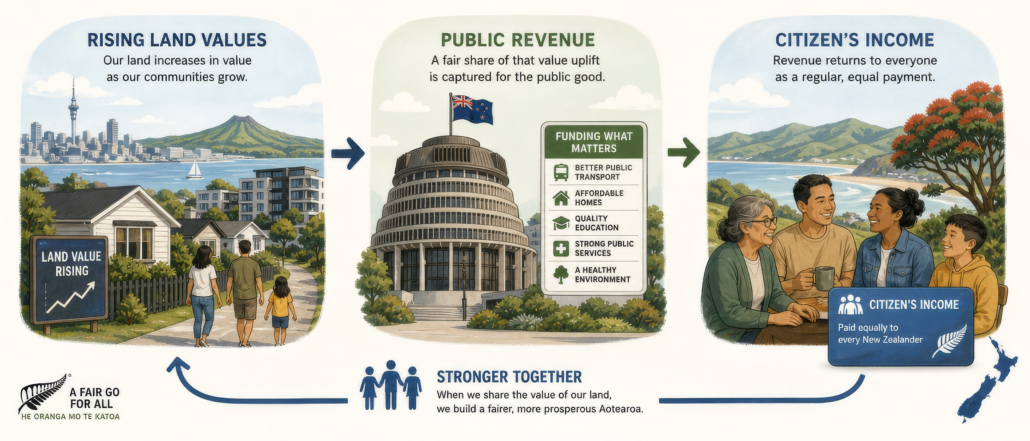
The New Zealand Opportunities Party proposal applies a 1.75 percent tax to land earnings. Supporters see this as an initial demonstration of how shared land value could finance a meaningful annual payment.
A higher rate could capture more land rent and reduce speculative land prices, but it would also require careful design to protect cash-poor households, preserve productive use, and manage the transition fairly.
A higher rate could capture more land rent and reduce speculative land prices, but it would also require careful design to protect cash-poor households, preserve productive use, and manage the transition fairly.
The larger point is not one exact dollar figure. It is that wealth created by communities, infrastructure, and public decisions does not have to flow only to landowners. Some of it can be returned to everyone.
New Zealand’s debate gives us a glimpse of what a Citizen’s Dividend could look like when land earnings is treated as a shared source of prosperity. Could a well-designed land value system provide citizens with US$20,000 a year – or more? That is a claim worth testing transparently, with clear assumptions and public evidence.
Follow the newsletter for more developments in economic-rent policy and practical ideas for sharing common wealth.
New Zealand’s debate gives us a glimpse of what a Citizen’s Dividend could look like when land earnings is treated as a shared source of prosperity. Could a well-designed land value system provide citizens with US$20,000 a year – or more? That is a claim worth testing transparently, with clear assumptions and public evidence.
Follow the newsletter for more developments in economic-rent policy and practical ideas for sharing common wealth.
Best regards
Ollie
and the Citizen’s Dividend Team