
In the late stages of all prior Real Estate cycles, and in financial markets, the story becomes more powerful than the numbers.
Investors stop asking what something is worth today and start asking how valuable it could become tomorrow. A new technology appears. A new generation of investors emerges – forgetting what happened in the prior real estate cycles.
It’s always been the same.
Someone makes an extraordinary amount of money. The returns attract attention, the attention attracts capital, and the capital creates even bigger returns.
Soon, the person making the predictions is no longer simply an investor.
He becomes a visionary.
In June 2024 Leopold Aschenbrenner, a 22-year-old former OpenAI researcher with zero prior professional trading experience, built a $24 billion hedge fund called Situational Awareness.
He did it by publishing a 165- page manifesto – titled, Situational Awareness – predicting the unstoppable arrival of Artificial General Intelligence (AGI) by 2027.
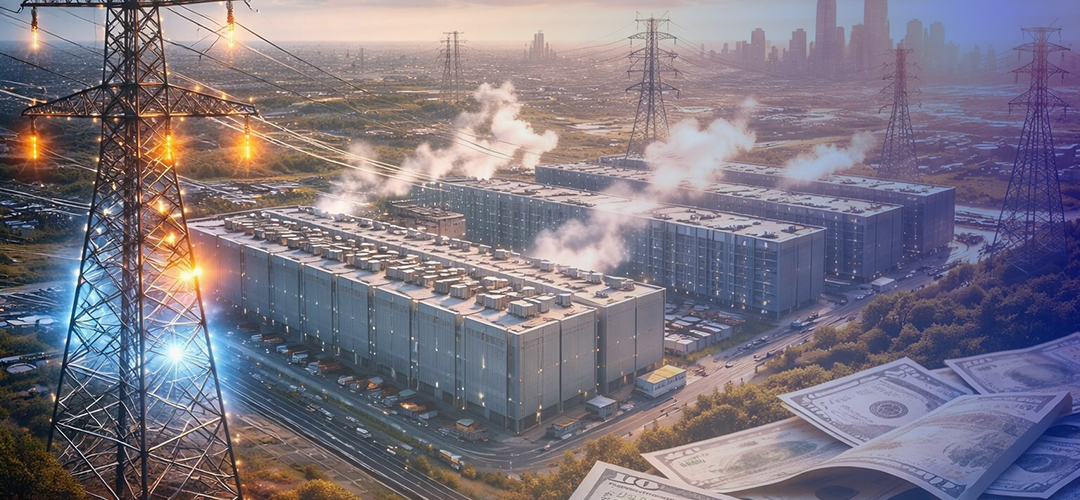
For Wall Street, Aschenbrenner’s manifesto mapped out the physical bottleneck of the future: trillions of dollars needed for specialized memory chips, massive data centers and power grids.
To investors, this is now the ultimate story.
A hype of AI fused to the tangible assets of the physical world (infrastructure, data centers, energy). AI is going to change the world, but it also needs something physical: more chips, more data centres, and enormous amounts of electricity.
The vision was so intoxicating that the Collison brothers (founders of Stripe) and tech investor Nat Friedman handed him hundreds of millions of their dollars to launch his aggressive investment vehicle.
Aschenbrenner wasn’t wrong that AI demands vast amounts of energy and hardware. But late-cycle psychology creates a dangerous blind spot: it makes people assume that being right about the direction of the future guarantees you will survive the journey there.
439% Returns
By the first half of 2026, Situational Awareness had reported 439% net gains… for just the first six months of the year.
And then…
…a sharp, sweeping correction hit the semiconductor and tech hardware sectors.
For an un-leveraged investor, a 35% drawdown is a bad quarter. For a fund running 400% leverage on concentrated positions, it triggers an immediate, existential crisis. As the value of the collateral fell, prime brokers like Goldman Sachs, JPMorgan, and Bank of America issued margin calls, demanding immediate cash.
Here’s the thing…
A near-crash does not always end the mania. Sometimes, it convinces investors that the crash was merely a temporary setback, giving them the confidence to take even bigger risks in the next round.
Anyway, Wall Street managed a quick bailout and we’ve all moved on.
Threat averted.
Here it is in chart form. Pay attention to the retrace it caused and the price and time retracement involved.
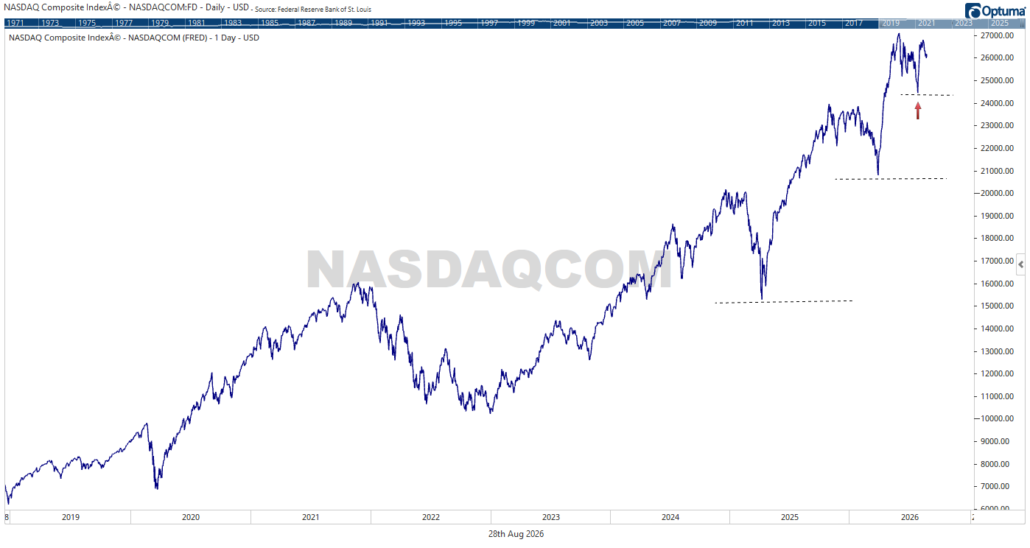
Source: Optuma / NASDAQ Composite Index
That’s the second canary; leverage.
Here’s your usual first canary: credit.
And it’s been getting more difficult over 2026 so far. With interest rates rising.
To understand why that matters, it helps to look back nineteen years. To a warning almost nobody outside the industry noticed at the time.
In early February 2007, HSBC Holdings, Europe’s largest bank, issued the very first profit warning in its 142-year history.
The bank revealed that provisions for bad debts in its U.S. subprime mortgage book (largely inherited through its acquisition of Household International) would come in about 20% higher than analysts expected, at roughly $10.6 billion.
Here’s how the chart looked back then too.
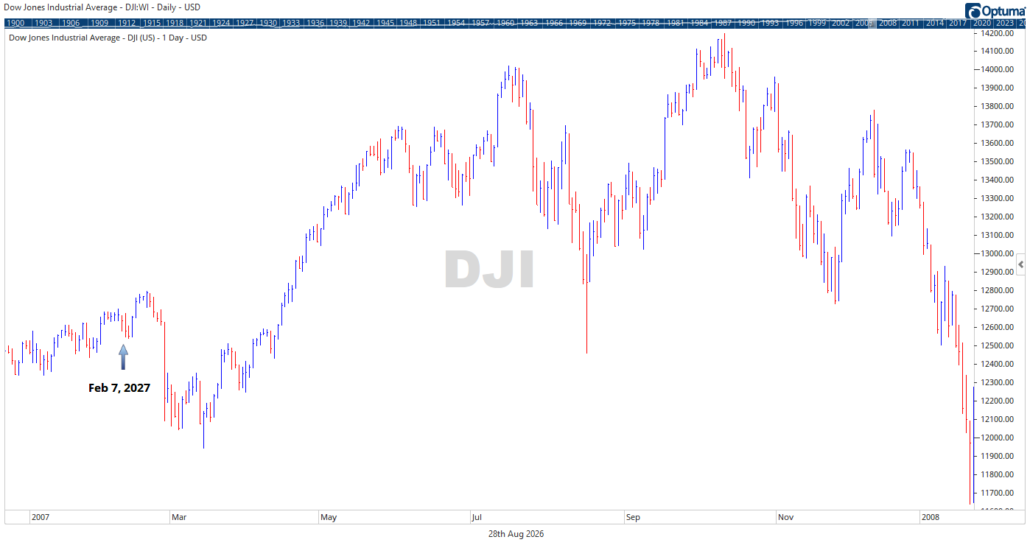
Source: Optuma / Dow Jones Industrial Average, 2007
At the time, markets barely blinked. It read as a one-off, a single lender’s underwriting mistake in a corner of the mortgage market nobody important was watching.
But it took place in the so-called Winner’s Curse phase of the 18.6-year real estate cycle.
Hence, it might pay to understand what’s happening right now.
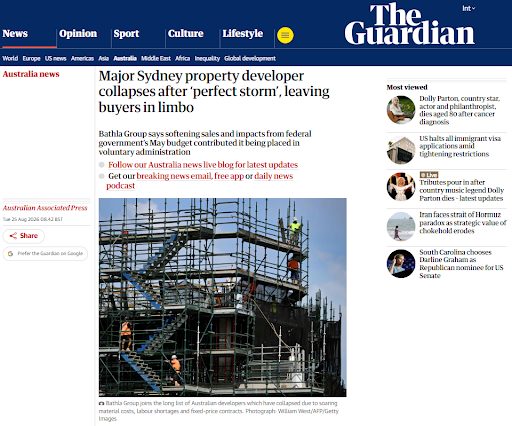
Australian property giant Bathla Group just collapsed under a AU$3.6 billion mountain of debt. For years, when big banks said no to risky projects, massive private credit funds have been stepping in with fast, high-interest loans. It worked great so far, but now the cycle may be turning.
Over half of the $250 billion private credit market in Australia is tied up in property development. And a lot of that money comes from ordinary people’s superannuation funds. Now that Bathla has gone bust, funds like Centuria Bass have frozen $670 million in withdrawals to stop panicking investors from pulling all their cash out.
Regulators are deeply worried that if property values drop or more builders’ default, everyday investors and super funds will be the ones losing money.
Check out the latest headline from The Guardian.
And so, this is why the most dangerous moment in the Winner’s Curse is often not when everyone knows the boom is over. It is when the boom has survived its first two canaries, and everyone concludes that it has proved them right.
Source: Optuma / Dow Jones Industrial Average, 2007

Your takeaway is this.
None of this could happen if we bothered to collect the Rent of natural resources and give it back out as a Citizen’s Dividend.
Since we don’t, the real estate cycle is bound to repeat. In fact, it must repeat.
The two canaries above aren’t a warning from the past, they’re the same story starting again.
Best regards

Ollie
and the Citizen’s Dividend Team